







“Phoenix Rising”
Written by J. Michael Straczynski
Directed by David J. Eagle
Season 5, Episode 11
Production episode 512
Original air date: April 1, 1998
It was the dawn of the third age… Another batch of bloodhounds arrive on the station and are briefed by Bester, which also brings the viewers up to speed. Bester wants as few casualties as possible, and also wants the bloodhounds to focus on the armed ones roaming the station. The ones locked in downbelow on a hunger strike aren’t going anywhere, and they can probably just wait them out. Lochley comes in at the end of the briefing and Bester assures her that everything will be fine. They enter a lift only to find a Psi Cop’s corpse nailed to the wall with “FREE BYRON” graffiti’d on the wall over the cop’s head. Lochley allows as how Bester may be optimistic.
Sheridan and Lochley talk to Byron, trying to convince him to surrender. However, Byron will not surrender to the Psi Corps and won’t leave until Bester is gone. Bester then interrupts and says that Byron never keeps his promises and Byron cuts off the communication in a snit. Sheridan rebukes Bester for spoiling what had been a potentially productive negotiation, and Bester tells him not to worry, as this will all be resolved by morning.
Bester then goes to his quarters to find Garibaldi pointing a PPG at him. Garibaldi demands that Bester make a full confession to what he did to Garibaldi. Bester refuses. When Garibaldi tries to pull the trigger on the PPG, he finds that he can’t. Bester smugly reveals that part of Garibaldi’s conditioning is that he cannot possibly bring harm to Bester. After Bester leaves, Garibaldi angrily shoots the computer, just to prove he can still use the PPG elsewise…
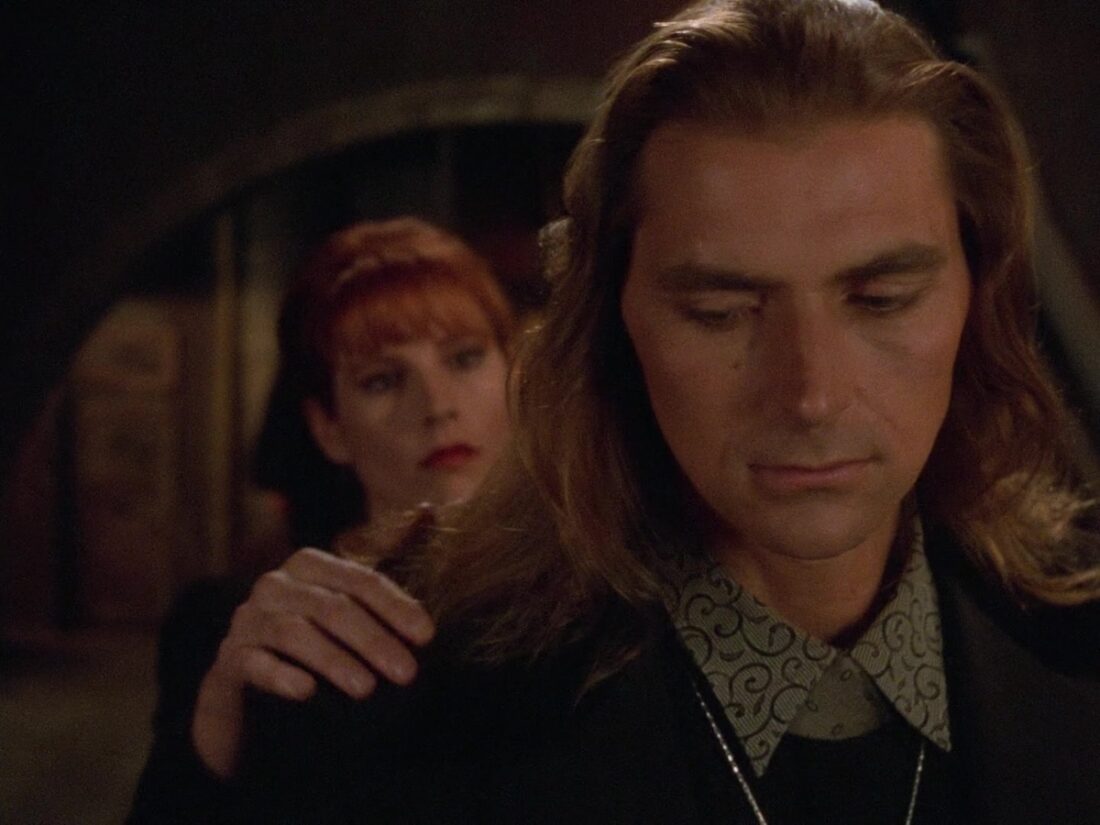
In downbelow, Alexander demands to know how Bester knows Byron, at which point he admits that he was a Psi Cop. During a mission, they captured some rogue telepaths. Once they were safe, Bester ordered Byron to shoot down the transport that taken on the rogues as passengers. Byron only did so reluctantly and because Bester ordered him to (“they’re just mundanes”). He filed a report, but nobody seemed to care. So he quit the Corps.
The rogue telepaths who are out and about are struggling. “Southey” tells Thomas that they’re in trouble, so Thomas suggests they fall back to medlab. They take the occupants hostage—among them, Garibaldi, who was there trying to find out from Franklin if a telepathic neural block can be reversed. Thomas demands that Byron be freed and orders Peter to guard the entrance to medlab with his telekinesis, which he uses to batter Allan and his people with random bits of debris.
Byron is devastated by what has happened and asks Alexander to find a way out of downbelow without cutting through the barricades. She uses her super-duper telepathy to find one, and they head to medlab.
Sheridan and Lochley discuss the situation. Bester still has jurisdiction, though Lochley has put in a request to EarthGov to let Lochley take command of the situation, since her people have been hurt. They agree not to give in to Thomas’ demands, and Sheridan contacts medlab to inform them of this.
In medlab, Garibaldi has been trying and failing to convince the telepaths to surrender. Once Sheridan rejects their terms, Thomas raises his PPG and points it at Garibaldi—but Byron arrives and shoots Thomas before he can kill Garibaldi. Byron then contacts Sheridan and Lochley and offers new terms. He and the telepaths who committed acts of violence will surrender—but only to the military, not to Psi Corps. The other telepaths must be allowed to go free. He also asks to speak to his people in downbelow before surrendering, again with no interference from Psi Corps. Sheridan and Lochley agree. Bester does not, but Lochley informs him that she just got word from Earth that she now has jurisdiction, so there, nyah nyah. Byron even goes so far as to turn in the identicards of all those who are surrendering, and also provide written confessions.
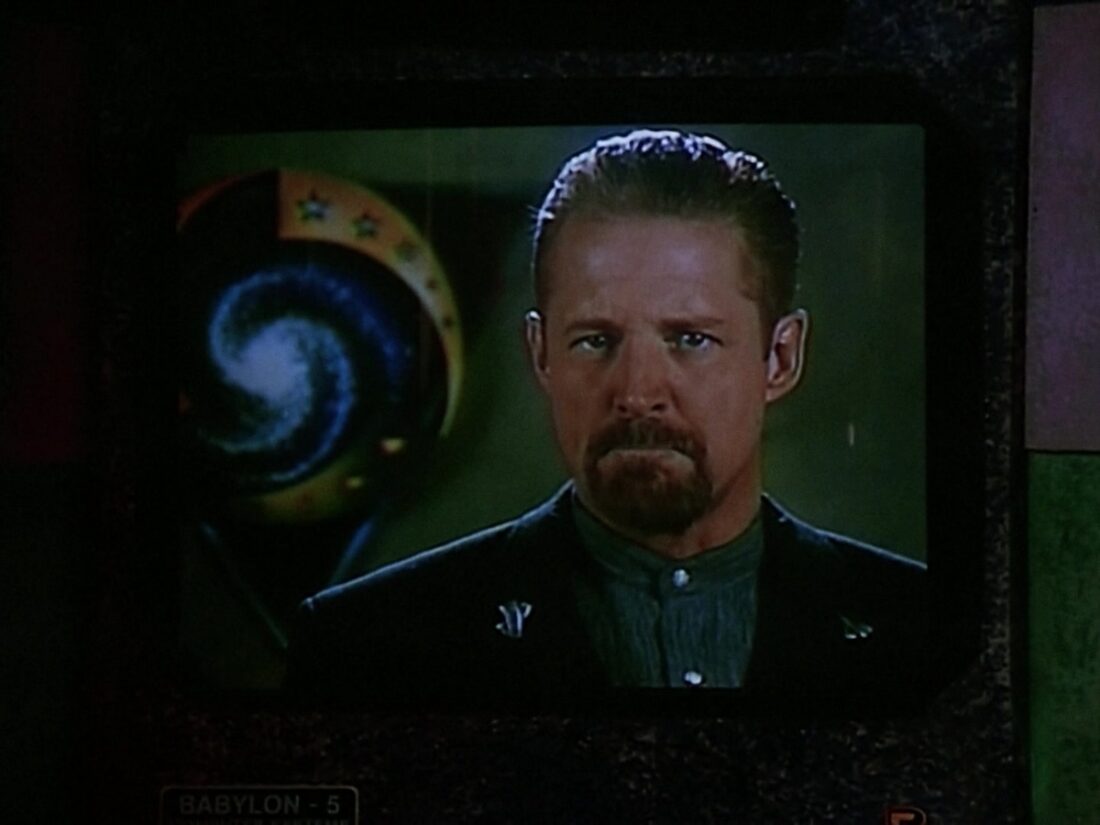
Bester goes to downbelow and tries to telepathically plead with Byron to surrender to him. Byron refuses.
Byron, Southey, Peter, and the rest of the gang go to surrender, and Lochley and Allan are about to take them into custody when Bester and his Psi Cops show up. Someone fires a weapon and all hell breaks loose. And then there’s a chemical spill, at which point everyone stops firing for fear of going boom.
After telling Alexander to walk away and exchanging some incredibly clichéd dialogue with her on the subject of love and loyalty and other nonsense, Byron shoots at the chemical spill, killing him and the other telepaths.
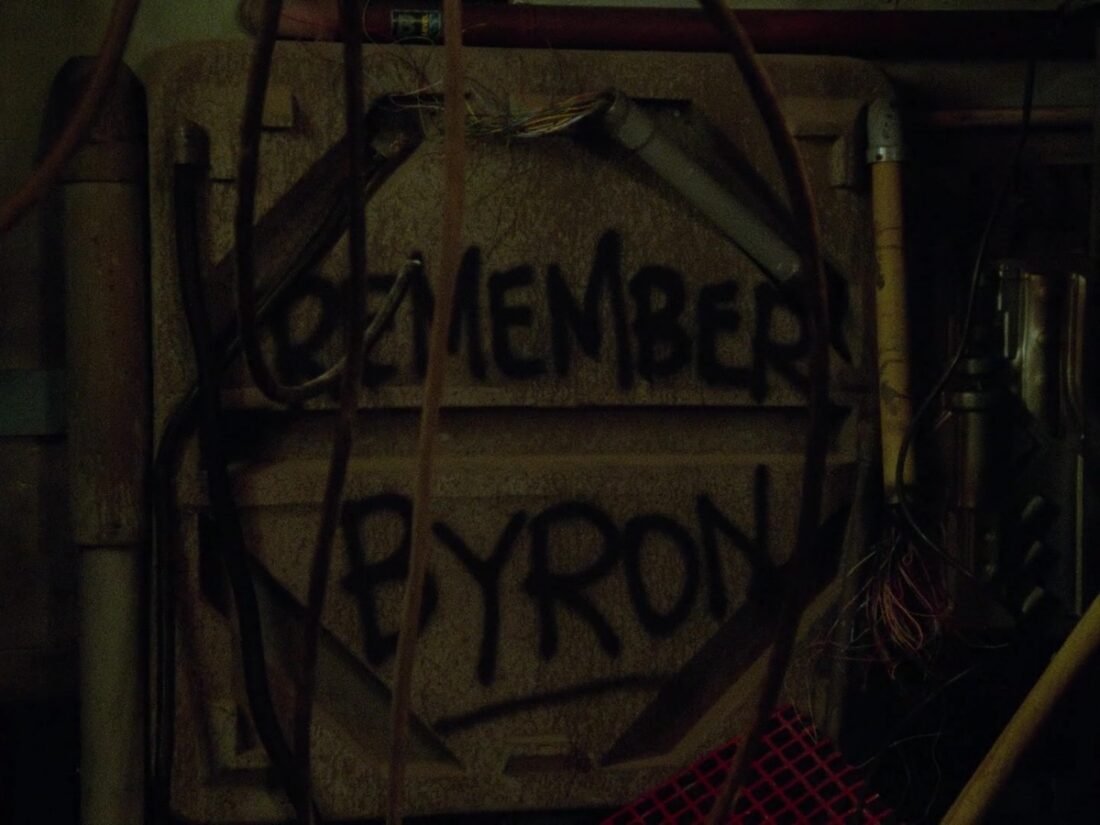
Bester is gobsmacked, as telepaths should all be on the same side. Alexander gives each of the surviving telepaths information from Byron that will help them get to safety. Franklin expresses concern about Garibaldi to Sheridan, and they pass by “REMEMBER BYRON” graffiti on the bulkhead.
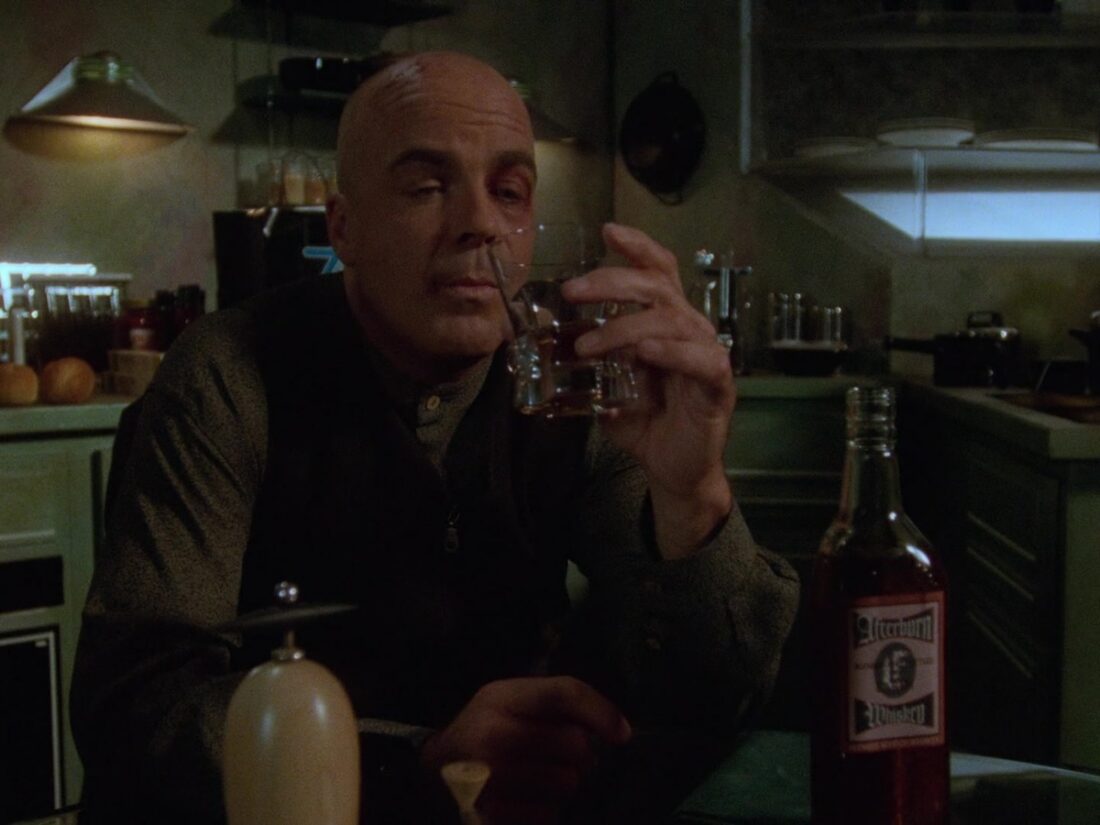
In his cabin, Garibaldi, listening to a news story about the bombing of Psi Corps HQ on Earth, pours himself a drink.
Get the hell out of our galaxy! Sheridan gets to give his first-ever “we don’t negotiate with terrorists” speech as president.
Never work with your ex. Lochley is able to talk EarthGov into giving her jurisdiction back from Bester. Because she’s just that awesome.
The household god of frustration. As if Garibaldi didn’t have enough reason to hate Bester, now he finds out that the conditioning extends even further to the point that he can’t get vengeance. This, and being beaten up and taken hostage, leads him back to the bottle.
The Corps is mother, the Corps is father. We find out that Byron was a Psi Cop. Also Bester genuinely thought that the telepaths would understand that Bester is on their side and won’t harm them, all the way to the end, a level of self-delusion that is, frankly, sad.
No sex, please, we’re EarthForce. Byron and Alexander have one final longing glance and awful dialogue before Byron blows himself and his friends up.
Looking ahead. The end of this episode was obviously meant to be a tipping point for the start of the oft-predicted and oft-referred-to Telepath War that has yet to be chronicled in any form.
Garibaldi falling off the wagon will continue to be a plot point this season.
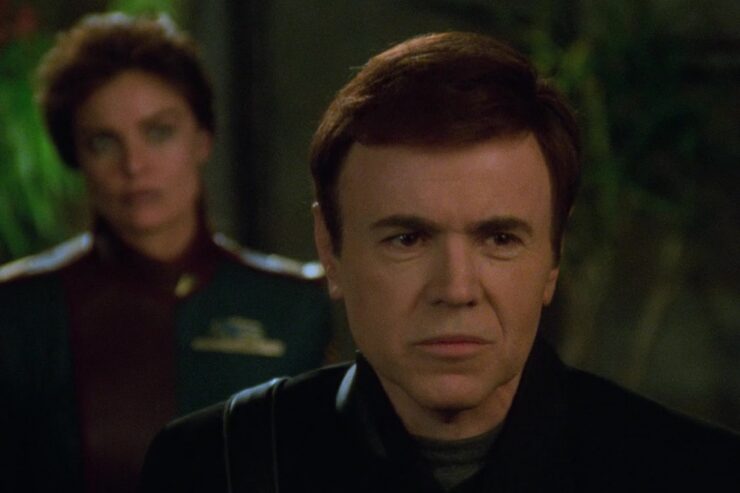
Welcome aboard. We have the final appearances of the following telepaths: Robin Atkin Downes as Byron and Leigh J. McCloskey as Thomas, both back from “A Tragedy of Telepaths”; Jack Hannibal as Peter, back from “Secrets of the Soul”; and Victor Love as “Southey,” back from “In the Kingdom of the Blind.” Walter Koenig, also back from “A Tragedy of Telepaths,” makes his penultimate appearance as Bester; he’ll be back in “The Corps is Mother, the Corps is Father.”
Trivial matters. Footage from “The Deconstruction of Falling Stars” of Garibaldi as the injured prisoner of renegade telepaths (and of Sheridan delivering his terms over the communication system) in a trashed medlab is used, and intercut with new footage expanding the events (including revealing who fired the weapon at the end of the footage in the older episode).
The song Byron sings before he blows himself up is the same one he and the gang sang at the end of “Strange Relations.”
The full story of what Bester did to Garibaldi was told in “The Face of the Enemy.” We get a few flashbacks to that episode.
Bester refers to the neural block he put on Garibaldi as an “Asimov,” as it’s based on the first of the Three Laws of Robotics that science fiction writer Dr. Isaac Asimov created in his robot fiction. That first law (which Bester mistakenly refers to as the first two laws) is “A robot may not injure a human being or, through inaction, allow a human being to come to harm.”
The echoes of all of our conversations.
“Every race to develop telepaths has had to find some way to control them, through laws, religion, drugs, or extermination. We may not be pretty, but we’re a hell of a lot better than the alternatives.”
—Bester, engaging in human-centric propaganda.
The name of the place is Babylon 5. “We are what we have become.” As I indicated last time, the rogue telepath story coming to a conclusion mostly just engenders relief that this tiresome plotline is coming to a merciful end.
One scene does stand out, and it’s Garibaldi’s confrontation with Bester, which is something we’ve been waiting for since “The Face of the Enemy,” after being denied it by Lochley tossing Garibaldi in jail when Bester was here last in “Strange Relations.” Jerry Doyle perfectly plays Garibaldi’s frustration, and Walter Koenig is magnificently smug as Bester asks Garibaldi if he thinks he’s an idiot.
It’s a beautiful scene that has the unfortunate side effect of showing up just how awful the rest of the episode is. The revelation that Byron was a Psi Cop is something that probably should’ve come up sooner—like when Bester was last on the station or when Byron and Alexander had hot telepathic monkey sex—and the plot points are dutifully checked off in a manner that is long on perfunctory and short on excitement.
The absolute worst is the climax when we have a whole bunch of armed people facing off against each other, and the entire thing grinds to a halt so that Byron and Alexander can have their cliché-drenched final conversation. Which is then followed by the explosion in an enclosed space that somehow only kills Byron and his people and doesn’t hurt anyone else. Sure. I buy that.
Once again, it’s left to Koenig to salvage the episode. Bester has spent most of his time on the station coming out ahead, and even when he loses, he doesn’t lose badly, or gets some manner of consolation. Here, though, he completely loses, and it’s obvious that a big part of why is that he was never able to get his arms around the notion of telepaths not being his people. He never saw Byron and his people as the enemy, but as prodigal children he was just waiting to welcome back.
Overall, this episode mostly makes me glad I won’t be subjected to the character of Byron or to Robin Atkin Downes’ inability to vary his facial expression hardly ever.
Next week: “The Ragged Edge.”

Thank goodness that’s over.
Most of Bester’s scenes have his dialog really well written. His confrontation with Garibaldi is the best, but some of the other scenes are very well delivered. But after he explained the “Asimovs” to Michael, I really wanted to take Garibaldi aside, hand him a copy of I, Robot, and tell him to read it and think about all the ways those laws can be subverted.
Also the scene with Best and the scene at the end show that Jerry Doyle could be a decent actor. Within a limited range, to be sure, but I think he pulls off both scenes. He’s nowhere near as good as some of the other headliners, but he’s not a complete hack.
It’s even easier than that: Bester is a PsiCop and rogue telepaths want him dead. He’s in a dangerous line of work,
So drugging him, taking him down to Episilon 3, and keeping him confined for the rest of his life is the best way to prevent him from coming to harm.
I suspect the problem is that Garibaldi wants him dead and rejects a loophole that leaves him safe and comfortable.
There are things I actually like about this episode, apart from the fact that it finally ends the telepath storyline. It’s pretty interesting seeing Bester fully in his Psi Cop routine. He truly believes that, in the end, telepaths will choose each other over any justice from the mundanes. He can’t wrap his head around why the rogues would resist the Corps.
What might have been, had Sheridan been willing to negotiate with Byron before this point? Or if Sheridan hadn’t withdrawn his sanctuary? I think the real tragedy (besides the casting of Byron) is that it could have ended differently. Even in this episode, had Bester not shown up at the end, it could have ended with less bloodshed. I think that’s what JMS was going for with this episode. Then again, when push came to shove, Byron had that martyr complex, and maybe it was just a question of how many people he would take down with him.
There’s a sad irony that Lyta, the one who perhaps should have understood Byron’s dreams the most, is the one who fosters the violent revolution against the Psi Corps. I always felt like this turn for her character made sense, given her overall arc. Though I do find it interesting that the “Remember Byron” thing kinda disappears pretty quickly!
In the script book commentary for this episode, JMS talks about how they ran out of time to get the final sequence with Byron done the way he intended. In particular, he was critical of how the explosion was pulled off. He admits they ran out of time. I think it shows in more moments than that. I always feel like one can tell that they were turning around the episodes in less time this season. Everything feels just a little rough around the edges in ways that weren’t as obvious in past seasons.
I didn’t think Byron’s arc made a lot of sense here. I’d gathered that the intent was supposed to be that he was actually a dangerous cult leader, leading his people to the point where they’d join him in a mass suicide, but there was no such buildup. He was portrayed throughout as this well-meaning pacifist trying to do the right thing, except then he suddenly, unmotivatedly decided to kill his followers and they suddenly, unmotivatedly went along with it. I just don’t buy it.
I also don’t like it when writers use telepathy as a grab bag of whatever powers are convenient for the needs of the plot at the moment. Since when did the power to read minds translate to the power to map ventilation ducts? (Now, if Lyta had been reading the sensory perceptions of the cockroaches or rats inside the ducts, that would’ve been kind of cool.)
It took me a moment to remember that we’d seen that scene of Garibaldi in Medlab before, as a flashfoward in “The Deconstruction of Falling Stars.” It seems a bit incongruous, because Doyle’s whole acting style seemed to change abruptly in the reused footage compared to the new footage. Also, who the heck was holding the camera to record that scene for future historians to replay?
It looked to me like Byron’s spacesuit nametag in the flashback read “Byron Geo…” with the rest cut off, but the wiki says his full name is Byron Gordon (which I’m guessing was established in the Psi Corps novels). Either way, it makes the reference to George Gordon, Lord Byron all the more blatant. Even though, as Keith has pointed out, the character had little in common with Lord Byron beyond an English accent and a fondness for waxing poetic. (Although as it turned out, he was dangerous to know.)
Lord Byron was also a revolutionary, which led to his death in Greece and him still bieng considered a hero there.
Lord Byron supported and fought in the Greek War of Independence, helped win popular support for the cause, and died of a possibly malarial fever exacerbated by bloodletting. All of which is pretty much the opposite of this Byron, a pacifist whose attempts to promote his cause just alienated people and who ended up killing himself and his followers out of the blue.
Lord Byron had a better writer.
Lyta’s campaign to make everyone remember Byron certainly has had success. We still do, almost 30 years later.
The biggest issue with the episode for me, Lyta and Byron’s sugary dialogue notwithstanding, is the way they handled Bester’s last-minute “interference”. EarthGov had already established jurisdiction over the situation, giving Lochley full authority to handle Byron’s people. Bester coming in like that with the bloodhounds, creating that mess, and then leaving like nothing happened with no repercussions. Seriously, where is the political fallout between EarthGov and Psi Corps over this blatant violation of jurisdiction? We get nothing, other than the newscast reporting Psi Corps bombing, which in itself is an action perpetrated by rogue telepaths.
Not to mention Byron’s sudden decision to commit mass suicide over a small ruckus feels artificial and staged like nothing else.
And Bester is coming back in two episodes like nothing’s happened. He clearly suffers no repercussions for his actions. Presumably being protected by the Corps. The whole reads like JMS himself realized how the Byron story dragged everything else down and just wanted to rush past it all.
As I’ve said before, Byron’s mysterious past was teased by Bester as this big ugly thing, and it turns out, he was a cop ordered to do some bad things, and just quit in disgust. Putting the whole ‘no one quits the corps‘ can of worms issue aside, Byron’s past is hardly more damning than the poor gunner who was ordered to shoot the Minbari during that first contact situation. I guess the idea is that Bester, for all his telepathic skills, is a really poor judge of people and character.
I keep imagining these scenes with Ivanova, if she had not left. But at least she was spared the sugary dialogue. And Lyta was already well positioned to be the voice of telepath rebellion against the Corps and keeping Byron’s memory and dream alive anyway.
Thankfully, we finally get some real consequence from Bester’s actions. Garibaldi’s return to the bottle was a long time coming. Old wounds that never truly healed, and issues that he could put aside for the mission for all these years. One of the better character arcs. That final shot of him dangling that drink is heartbreaking.
Remember that President Clark spent most of his time in office giving Psi Corps more power and influence. As Edgars pointed out to Garibaldi, they’re not going to give up that power easily or readily, so I’m not even a little surprised that there were no consequences to Bester’s actions here.
—Keith R.A. DeCandido
“And Bester is coming back in two episodes like nothing’s happened. He clearly suffers no repercussions for his actions. Presumably being protected by the Corps.”
“Lyta’s campaign to make everyone remember Byron certainly has had success. We still do, almost 30 years later.”
Actually I’d mostly forgotten about Byron until this rewatch.
I remembered the Garibaldi and Bester bits, but not the context.
I can only nod agreeingly with the post and the comments.
It’s very strange that the telepaths started this conflict by scanning the alien ambassadors for their secrets and part of the point of the hunger strike was to get the other worlds to feel more sympathetic towards their cause. And yet the aliens take no part in the resolution of this plot and aliens aren’t even really in this episode at all. Nobody even appears concerned that the surviving telepaths are leaving with the secrets they supposedly gleaned. This telepath plot is just kind of all over the place. At least it’s over.
I think that Byron’s past as a Psi Cop and the incident with him and Bester was a last ditch attempt by JMS to make Bryon (“But you may call me Lord”) more sympathetic as he brought this storyline to a close. The problem is two-fold: 1) I agree with Keith that it should be been brought up much sooner (at least hints or pieces, even if the full, complete story is revealed at the end); 2) There is no way Robin Atkin Downes could have pulled it off (the PTSD from the incident) consistently during the entire run. (And unfortunately, we have PTSD from this terrible storyline and RAD acting…)
As I once said, “When you find yourself rooting for Bester, you know something is wrong.”
Just one last thing: in what universe did Bester (and JMS) think that destroying any kind of transport and its passengers and crew wouldn’t get noticed by EarthGov and the public. And why didn’t Bryon just go public with what happened (not just filing a report)?
IIRC, this incident with Byron is covered in the middle book of the Psi Corps trilogy. There might be more detail included with that particular retelling, but to be fair, I don’t remember at this point.
But Bester’s intent seems to be that he *wants* it known that the transport was lost. He wants to send the message that helping rogue telepaths is risky business. All he wants to hide is that Black Omega squad did the deed, at least from official reports.
It does raise a few questions, though. If Byron was Bester’s protege, how could this incident have been the tipping point? We know from earlier episodes that Lyta interned with the Psi Cops and saw far more heinous things. As Bester’s protege, are we supposed to believe this was the worst thing Byron had witnessed? Leaving aside that Byron himself had expressed a low opinion of mundanes.
I suppose that it could be said that Byron had more and more misgivings with the violence expected from a Psi Cop, and this was just the last straw, but that’s not quite the way things are framed.
Space is big and empty, so ships could easily “disappear” without explanation if it happened deep enough in space. As for Byron going public, there tend to be a lot of penalties to discourage members of organizations from revealing their secrets, and I expect Psi Corps’s are pretty harsh.
And Lyta’s dogged reverence for (and “monkey sex” with – I like that…) Byron is more than a bit hypocritical. She resents strongly (rightly so!) how she’s been used as a tool for almost all of the other characters (except for, perhaps, Zach), and yet, she winds up hopelessly devoted to – and used by – another “of her own kind”. Of course we’ll “remember Byron” – but certainly not fondly.
I found a couple good moments with this episode; one, as you described, KRAD, the interplay between Best (damn; Koenig was good!) snd Garibaldi, the other was the feeling of relief that we ddidn’t have to watch Byron, any more.
I think we’d have been better to cut this thread way short and devote what was cut it to the actual telepath war (which would be
I just don’t know what to think about Byron and the whole telepath arc…
If JMS intended him to come across as a dangerous cult leader, he failed, perhaps catastrophically. Byron is shown in the end to have little sway over the majority of his followers with regards to one of his core tenets (“no violence”). He claims to be a pacifist, but isn’t above violating the minds of the alien ambassadors and encouraging his followers to do the same. Or perhaps he’s only against acts of physical violence?
If JMS intended for Byron to demonstrate how cults can be charismatic, he failed, perhaps catastrophically: Byron himself shows no interest in actually leading anyone (perhaps the most criminal act he commits is his shrugging when he knows his followers are going to go off and commit violence on his behalf). The telepaths shown are pretty uniformly uncharismatic and frankly a bit creepy (maybe that’s inevitable when you’re a human telepath in the B5-verse)? They come across more as a bunch of goth poseurs, and ones with zero personality to boot.
If JMS intended for Byron to come across as intellectual rather than pseudointellectual, he failed, perhaps catastrophically: How anyone could think that the plan to eavesdrop on the ambassadors and then blackmail them with their secrets would encourage anyone to give the telepaths a homeworld of their own beggars belief. I wouldn’t have blamed the ambassadors for granting the telepaths’ request, and then nuking the planet once they were all settled.
I know JMS lost his notes and consequently had to somewhat improvise this plotline, but what a mess, with failures along multiple lines.
I agree with everything you said except for “perhaps.” :laughs:
—Keith R.A. DeCandido